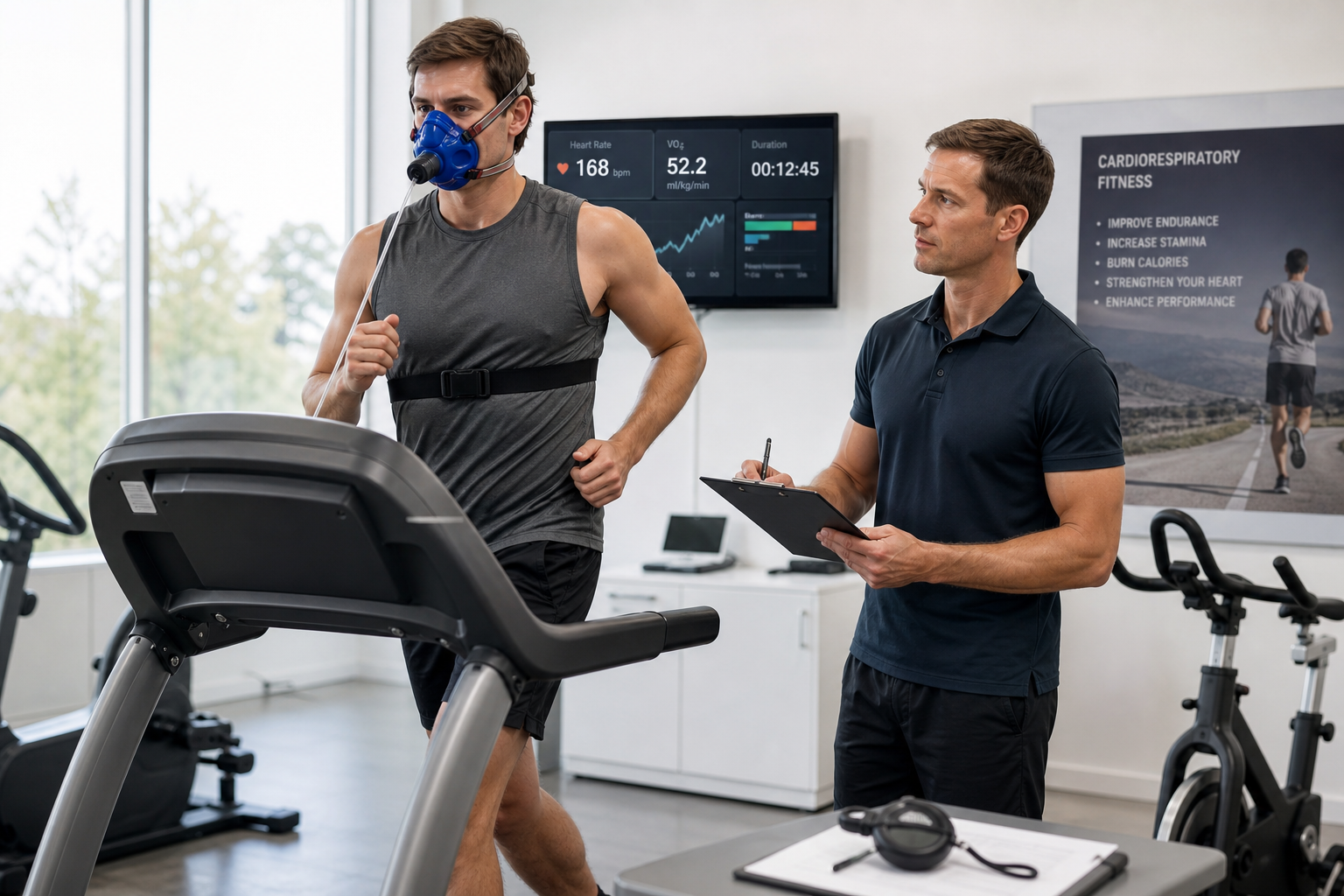

Cardiorespiratory Fitness


Designing an effective cardiorespiratory workout can make a meaningful difference in achieving fitness goals. Whether the objective is improving endurance, supporting fat loss, or enhancing cardiovascular health, understanding how to structure exercise variables is essential.
The FITT-VP principle provides a practical framework for organizing cardiorespiratory exercise. FITT-VP stands for Frequency, Intensity, Time, Type, Volume, and Progression. Together, these elements help trainers and exercisers create programs that are individualized, measurable, and adaptable over time.
In this guide, we’ll break down each component of FITT-VP, explain how it applies to cardiorespiratory training, and show how the framework can be adjusted for different fitness levels and goals.
Big Idea Question
How can the FITT-VP principle help create safer, more personalized, and more effective cardiorespiratory workouts?
Lesson Summary
This article explains how Frequency, Intensity, Time, Type, Volume, and Progression work together to guide cardiorespiratory exercise programming. It includes practical ranges, goal-based applications, monitoring methods, and a sample 12-week plan.
The FITT-VP principle is a framework for creating individualized exercise programs. It helps organize the major variables that determine how a cardiorespiratory workout is structured and progressed.
Each element plays a distinct role:
How often exercise is performed.
How hard the exercise feels or how demanding it is physiologically.
How long each session lasts.
The activity or mode of exercise selected.
The total amount of exercise performed.
How the program is advanced over time.
Cardiorespiratory exercise includes activities such as running, walking, cycling, swimming, and rowing. The FITT-VP model provides a systematic way to organize these workouts around a person’s goals, current fitness level, preferences, and response to training.
FITT-VP helps transform a broad goal like “improve cardio” into specific training decisions about how often to exercise, how hard to work, how long to train, what activity to choose, how much total work to complete, and when to progress.
Frequency refers to the number of cardiorespiratory exercise sessions performed each week. The appropriate frequency depends on training goals, current conditioning, exercise intensity, and recovery capacity.
Consistency is often more useful than sporadic, highly demanding sessions. A sustainable schedule makes it easier to accumulate meaningful training over time.
Intensity describes how hard the body is working during exercise. It can be monitored in several ways, and no single method is ideal for every person or situation.
Heart Rate Zones: Target heart rate can be used to estimate exercise intensity relative to a person’s maximum heart rate or heart rate reserve.
Ratings of Perceived Exertion (RPE): The traditional Borg scale ranges from 6 to 20 and allows the individual to report how difficult the exercise feels.
Metabolic Equivalents (METs): METs express the energy cost of an activity relative to resting metabolism.
Moderate intensity is often appropriate for general health and aerobic base building, while higher-intensity intervals can be incorporated when they match the individual’s goals, experience, and readiness.
Time refers to the duration of each exercise session. The appropriate duration depends partly on intensity and the total weekly exercise target.
The goal is not simply to make sessions longer. Duration should be balanced with intensity, recovery, and the individual’s ability to maintain good exercise quality.
Type refers to the mode of cardiorespiratory exercise. The best option depends on goals, preferences, orthopedic considerations, access to equipment, and training experience.
Accessible options for building general endurance.
A lower-impact option that can be adjusted across a wide range of intensities.
A full-body, low-impact mode of cardiorespiratory exercise.
A full-body option that can be used for steady-state or interval training.
Using more than one activity can help maintain interest and distribute repetitive stress across different movement patterns.
Volume represents the total amount of exercise completed over a period of time. It reflects the combined effect of frequency, intensity, and duration.
Appropriate for beginners or individuals who are establishing exercise consistency.
Balances exercise duration, frequency, and intensity for ongoing improvement.
May be appropriate for endurance athletes or advanced trainees with goals that require larger workloads.
Tracking total workload helps determine whether the program is increasing too quickly, remaining stagnant, or progressing in a sustainable way.
Progression refers to gradually increasing the training challenge so that the body continues adapting. Progress can be created by adjusting frequency, intensity, duration, or total volume.
A commonly discussed guideline is the 10% rule, which suggests limiting weekly workload increases to approximately 10%. This can be a useful starting concept, but progression should ultimately be individualized based on the person’s training history, recovery, symptoms, and response to exercise.
Progression should be earned through adaptation—not forced simply because another week has passed.
Periodization can also be used to organize changes in training volume and intensity across different phases of a program.
The value of FITT-VP is its flexibility. The same framework can be adjusted based on the outcome the individual is trying to achieve.
Weight Management: Greater weekly frequency or duration may help increase total energy expenditure while maintaining a sustainable intensity.
Endurance Training: Longer durations, greater total volume, and planned progression may be emphasized.
Cardiovascular Health: Consistent moderate-intensity aerobic exercise and activity variety can provide a practical foundation.
Tracking performance and exercise response allows FITT-VP variables to be adjusted using real information rather than guesswork.
FITT-VP is not a one-time prescription. As fitness changes, the program should change with it.
The following example shows how FITT-VP can be used to organize a 12-week cardiorespiratory plan for an intermediate exerciser.
Build an aerobic base with four days of moderate-intensity continuous training, 30-40 minutes per session.
Add interval training twice per week while maintaining moderate-intensity sessions.
Increase interval duration or intensity gradually and add cross-training for variety.
Rest and recovery days should be included based on the total workload and the individual’s response to training.
FITT-VP stands for Frequency, Intensity, Time, Type, Volume, and Progression. These variables help organize and individualize an exercise program.
It provides a structured way to determine how often to train, how hard to work, how long to exercise, which activity to use, how much total work to perform, and how the program should progress.
Common methods include heart rate, Rating of Perceived Exertion, workload, pace, and METs.
Exercise volume refers to the total amount of exercise performed and reflects the combined effects of frequency, intensity, and duration.
Progression refers to gradually increasing the training challenge over time as fitness improves.
The FITT-VP principle offers a flexible approach to designing cardiorespiratory exercise programs. By adjusting frequency, intensity, time, type, volume, and progression, trainers can create programs that better reflect the needs and goals of the individual.
The framework is especially useful because it encourages ongoing monitoring and adjustment. As fitness improves, the program can evolve instead of remaining static.
Successful cardiorespiratory programming is not about finding one perfect workout—it is about using the right variables, monitoring the response, and making informed adjustments over time.
Understanding how to manipulate exercise variables is a core skill for personal trainers, coaches, and exercise science professionals.
Explore Lionel University’s certificate and degree pathways to continue building your knowledge of exercise science, cardiorespiratory training, program design, and human performance.